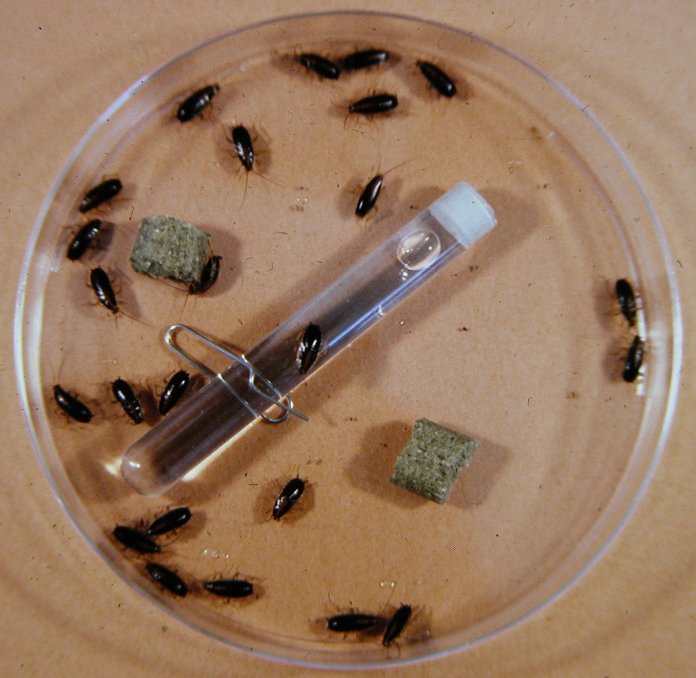

Field comparison: markings change with species and stage
A cockroach nymph has no fully developed adult wings. San Diego County’s species comparison describes brownbanded nymphs with pale bands across the back, while American nymphs have darker sides and segment edges. These patterns are more useful than describing every small roach as black.
A hairy, caterpillar-like body contradicts the usual cockroach-nymph comparison. Three long tail filaments suggest a silverfish comparison instead. If those features are not visible, record the uncertainty rather than assuming that all small, wingless household insects are roaches.
Reference: San Diego County: Cockroach species and signs · University of Maryland Extension: Silverfish and Firebrats
What to check and record
- Record body length separately from the antennae. An estimate with its units is more useful than “tiny.”
- Take a view from above that includes the head, back, and abdomen. Note any stripes or crossbands without assuming what they mean.
- Look for other sizes of the same insect in the same area. Record each sighting separately rather than estimating a hidden population.
Compare the alternatives
German cockroach nymphs differ from adults in wing development and coloration. The laboratory photo here shows one species and one growth stage, not every baby roach.
A beetle, bed bug, or other small insect can look roach-like in a blurred image. Compare the whole body rather than a cropped dark oval.
Why a pale cockroach is not a separate species
A newly molted German cockroach can appear pale before its outer covering darkens. UF/IFAS documents this change. A white insect therefore needs body features and context, not a special “white roach” diagnosis. Photograph it as found; color at one moment is only one part of the identification.
Reference: UF/IFAS: German Cockroach
Compare a nymph with a nymph
Use a reference labeled for the immature stage. An adult’s developed wings can conceal markings that are obvious in a young insect, while an adult female of another species may have reduced wings. Start with the body outline, antennae, and markings together. If your photograph does not show those details, a match based only on small size is not sufficient.
Build a location record for young insects
List each finding by room and exact object: under a sink lip, within a box, or beside an exterior threshold. Keep the smallest and largest observed insects in separate images. This helps a specialist assess whether several life stages are present. Do not convert a mixture of sizes into an estimated age of the infestation; growth and visibility do not provide that clock.
Ask for confirmation before choosing a response
Send the best image and body-length estimate, then ask whether an adult or specimen is needed. In a shared building, preserve the same observation labels when reporting to management. If the insect was found in an incoming item, record that fact without assuming it explains every later sighting. The management plan should follow the identified species and inspected locations.
Keep the context with the clue
Record the date, exact location, visible features, and what remains uncertain. Bring the record to a qualified identifier.
Add this finding to your evidence log →Common questions
Does one baby roach prove there are hundreds?
No. A sighting deserves investigation, but it does not provide a reliable population estimate. Record where and when it appeared and look for corroborating evidence.
Does a wingless roach always mean it is a baby?
No. Wing development differs by species and sex as well as age. Adult female Oriental cockroaches, for example, have reduced wings. Compare the whole insect.
Can a nymph identify where the infestation started?
A finding documents where you saw that insect. It does not establish the original introduction point, the age of a population, or who introduced it. Keep those questions open unless inspection evidence resolves them.
Sources reviewed
These references support the identification notes. They do not imply that the authors have reviewed or endorsed this website.